
Medical and health document intelligence
Understand Lab Results, Discharge Summaries, and Medical Reports in Plain English with AI
Upload a lab report, discharge summary, radiology report, or insurance statement and ask questions about it the way you would ask a knowledgeable friend. LearnByAi explains what the document says in plain English, so you can walk into your next appointment with better questions. It does not diagnose or give medical advice.
- No account required to start
- Delete anytime
- Scanned reports supported
Last updated

What is AI medical document analysis?
AI medical document analysis means using artificial intelligence to read a health document and answer questions about it. Instead of searching a six-page discharge summary for the medication list, or guessing what an unfamiliar term in a lab report means, you ask a question and get an answer written in plain language.
LearnByAi does this with retrieval. Your document is split into sections and indexed, and each question is matched against the most relevant passages before an answer is written, so answers come from the text of your own document rather than from general knowledge. It explains what your document says. It does not diagnose, and it cannot tell you what your results mean for your health.
Which medical documents can you analyze with AI?
You can upload most of the paperwork that comes out of a clinic, lab, or hospital, including:
- Blood test and lab reports (CBC, metabolic panel, lipid panel)
- Hospital discharge summaries
- Radiology reports (X-ray, CT, MRI, ultrasound)
- Prescriptions and medication lists
- Pathology reports
- Doctor's notes and clinic visit summaries
- Referral letters
- Vaccination and immunization records
- Insurance explanation of benefits (EOB) statements
- Health insurance policy documents
- Consent forms and patient information leaflets
- Clinical trials and medical research papers
Supported files: PDF, DOCX, XLSX, and TXT files, plus JPG, PNG, and TIFF images. Scanned PDFs and photos of documents are processed automatically with OCR so you can search and ask questions about their text.
How to understand a medical report with AI in four steps
You do not need a medical background or any setup.
- Upload the document. Add a PDF, Word file, or a scan or photo of the report. Scanned pages are read with OCR automatically.
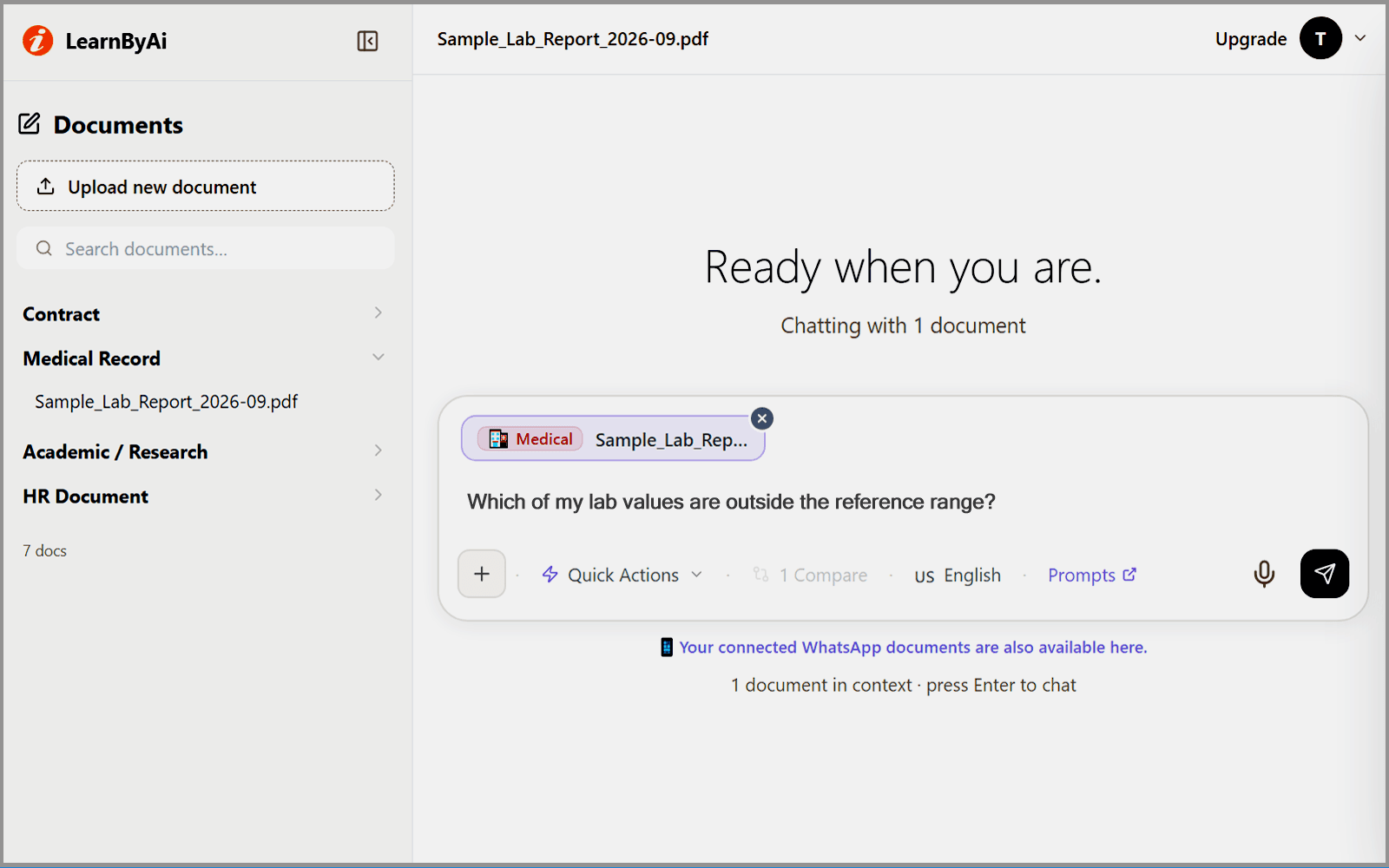
- Ask a question in plain words. For example, “Which of my results are outside the reference range?” or “What does this term mean?”
- Read the answer and check the original. Answers are based on the text of your document. Check the values and wording against the original report.
- Prepare for your appointment. Ask follow-up questions, then write down what you want to ask your doctor.
What you can do with LearnByAi medical document analysis
Every answer is based on the document you uploaded, and none of it replaces your care team.
Understand your lab results
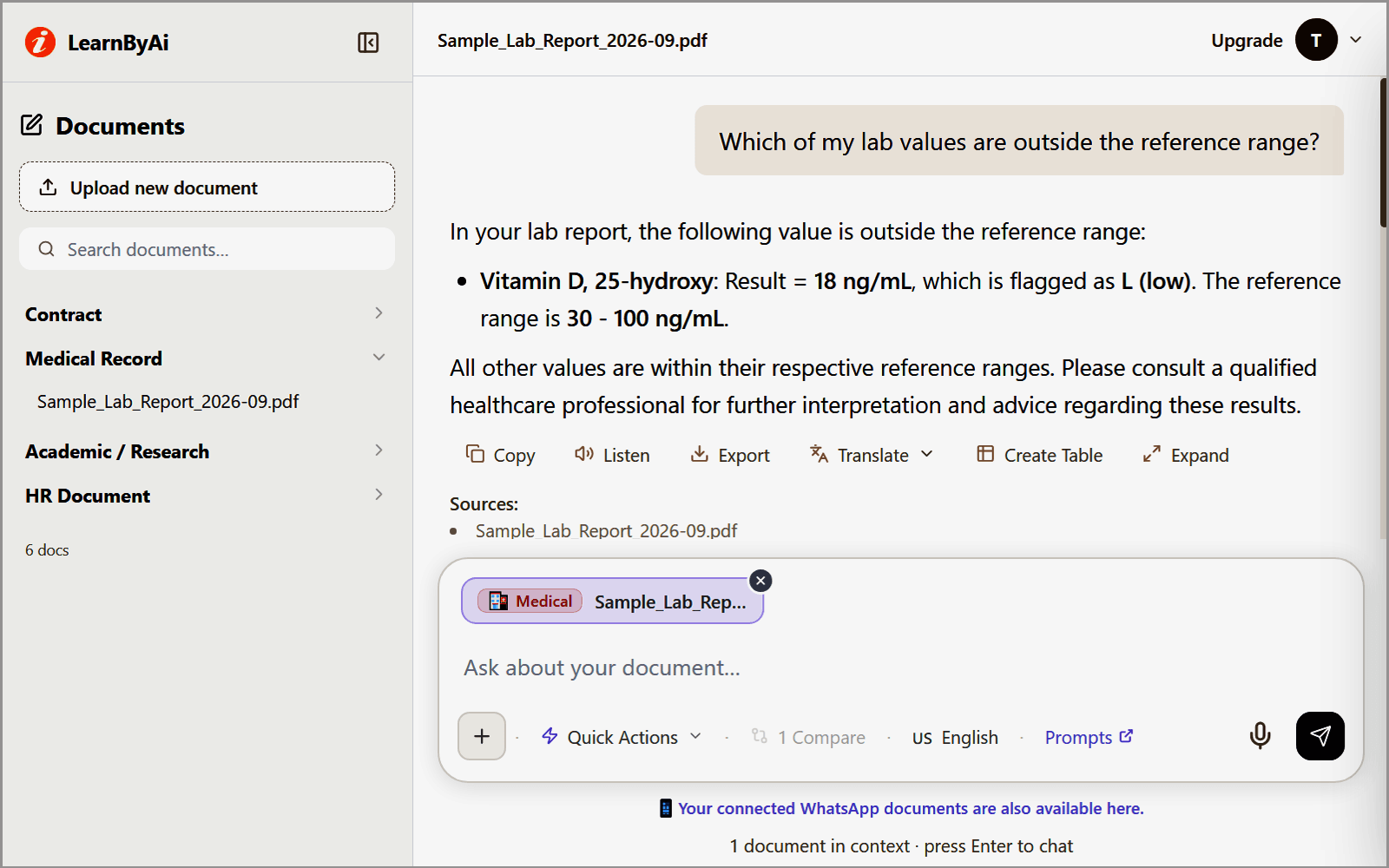
- Ask which values are flagged as outside the reference range on your report.
- Get a plain explanation of what a test generally measures, using the ranges printed in your document.
- Upload two reports from different dates and ask which values changed.
Try asking: “Which of my lab values are outside the reference range?”
Translate medical terminology and imaging reports
- Turn clinical wording such as “bilateral pleural effusion” into plain English.
- Understand the findings and impression sections of an X-ray, CT, MRI, or ultrasound report.
- Get abbreviations and unfamiliar terms explained in the context of your document.
Try asking: “Explain the impression section of this MRI report in plain English.”
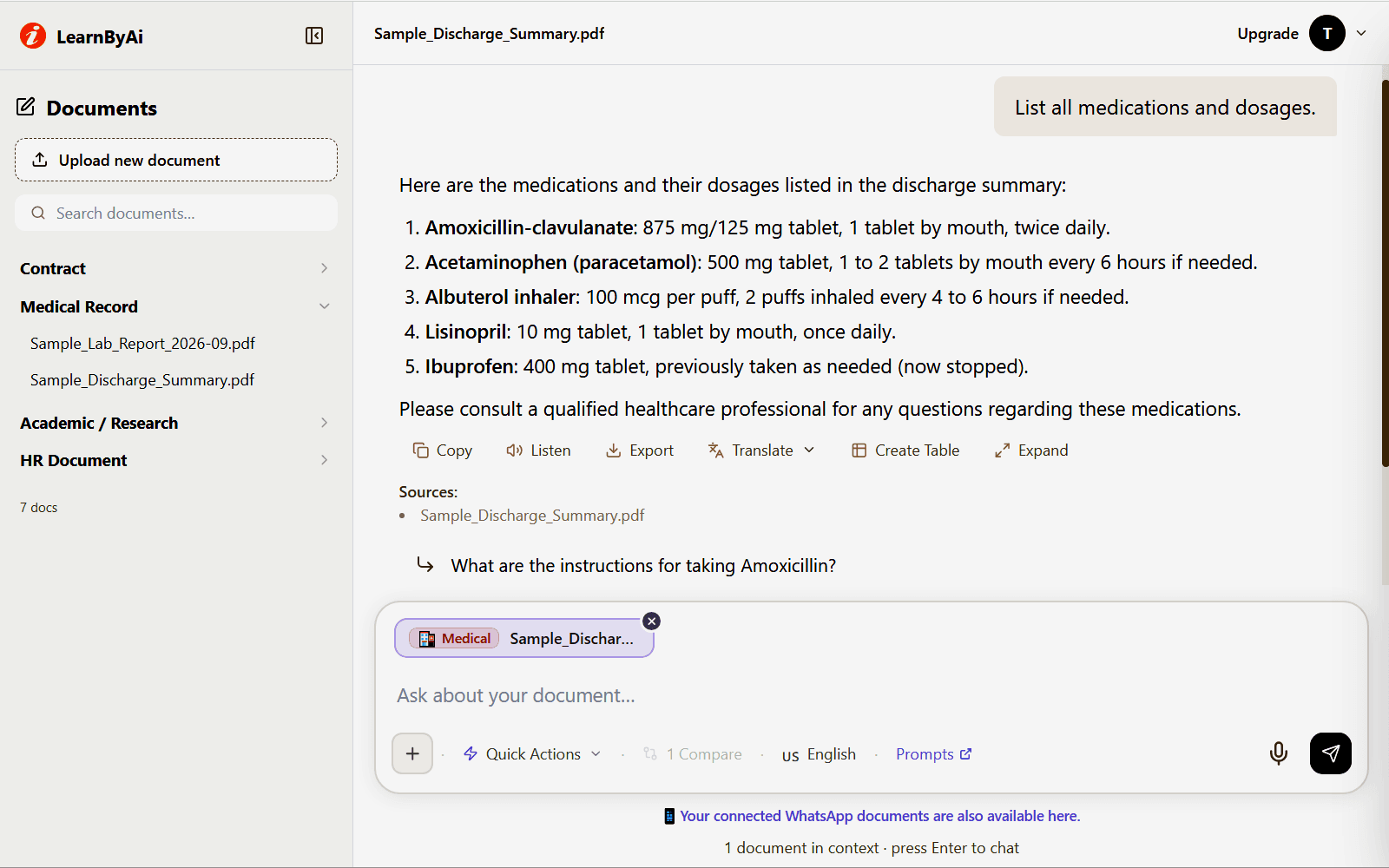
Pull the medications and instructions from a discharge summary
- List every medication with its dose, frequency, and instructions as written in the document.
- Collect the discharge instructions and the warning signs the hospital listed.
- Use the result as a list to confirm with your doctor or pharmacist, not as dosing advice.
Try asking: “List every medication in this discharge summary with its dose and frequency.”
Find follow-up appointments and next steps
- Surface recommended follow-up visits, tests, and referrals that are buried in long clinical notes.
- Put the next steps in one list so nothing is missed after a hospital stay.
- Note any dates or deadlines the document mentions.
Try asking: “What follow-up appointments or tests does this summary recommend?”
Make sense of insurance statements and policies
- See what an explanation of benefits (EOB) lists as billed, allowed, and your responsibility.
- Find exclusions, limits, and pre-authorization requirements in a policy document.
- Ask what a policy says about a specific procedure or medication.
Try asking: “What does this EOB say I owe, and why?”
Navigate medical research papers
- Ask about study design, sample size, inclusion criteria, and the primary outcome.
- Find the limitations the authors state without reading every page.
- Compare two papers on the same question.
Try asking: “What was the primary outcome of this clinical trial?”
Example: asking which lab values are outside the reference range
This is an illustrative example based on a fictional sample lab report. The numbers are invented for demonstration.
Question: Which of my lab values are outside the reference range?
Two values on this report are flagged as outside the reference range.
Flagged values
- Creatinine: 1.6 mg/dL, above the reference range of 0.7 to 1.3 mg/dL.
- Vitamin D: 18 ng/mL, below the reference range of 30 to 100 ng/mL.
What these tests measure
- Creatinine is a waste product that doctors use as one measure of how well the kidneys are filtering.
- Vitamin D is a measure of the vitamin D in your blood.
Note: A value outside the reference range does not mean something is wrong on its own. Results depend on many things, so ask your doctor what these values mean for you.
Source: Comprehensive Metabolic Panel, page 1 of the uploaded sample report.
Questions to ask when you analyze a medical report with AI
These are starting points. You can ask anything about your document.
- Which of my lab values are outside the reference range?
- What does the creatinine test on this report measure?
- Explain this radiology report in plain English.
- What is the impression or conclusion of this MRI report?
- List all medications, doses, and frequencies in this discharge summary.
- What follow-up appointments or tests does this summary recommend?
- What warning signs does the discharge summary tell me to watch for?
- What is the patient responsibility amount on this EOB?
- Which values changed between my two lab reports?
- What was the primary outcome of this clinical trial?
Looking for more? Browse our AI prompts for medical reports: ready-to-use questions for lab results, discharge summaries, imaging reports, insurance statements, and research papers, which you can send to the chat in one click.
Who can use AI to understand medical documents?
Anyone who has received health paperwork they find hard to read, including:
- Patients. Read lab results and clinic notes before an appointment, and write down questions for your doctor.
- Caregivers and family members. Help a parent or relative understand their records, with their permission.
- People leaving the hospital. Collect your medications, instructions, and follow-up steps from a long discharge summary.
- Health insurance members. Understand an explanation of benefits or what your policy covers before you pay a bill.
- Medical and nursing students. Find the methods and outcomes in research papers and sample case documents faster.
- Researchers and health writers. Pull the design, sample size, and stated limitations out of studies, then check the full paper.
What AI medical document analysis can and cannot do
AI is a fast way to read and understand a document. It is not a doctor.
- LearnByAi explains what a document says. It does not diagnose conditions, recommend treatments, or give medical advice.
- Never change or stop a medication, or delay care, because of an answer from this tool. Confirm with your doctor or pharmacist.
- Reference ranges vary by lab, age, and sex. Rely on the ranges printed on your own report, and let your doctor interpret your results.
- AI can misread or miss details. Check important values and wording against the original document.
- Handwritten notes and low-quality scans are often read incorrectly.
- If you think you may be having a medical emergency, contact your local emergency services instead of using this tool.
Privacy for medical records
Medical records are personal. LearnByAi does not claim HIPAA compliance, so healthcare providers, insurers, and business associates that handle protected health information should not upload patient records without approval from their compliance team. This is how LearnByAi handles uploaded documents:
- Each document is accessible only from your own session or account, and other users cannot open it.
- Your documents are sent to our AI provider only to generate answers. How that data is handled is described in our Privacy Policy.
- Anonymous-session documents are cleaned up automatically once the session goes idle.
- You can delete a document manually at any time.
For the full details, read our Privacy Policy and Security page.
Free to start, pay as you go
Free allowance: 10 logical pages and 10 messages per day with no account, or 30 logical pages and 15 messages per day with a free account.
If you need more, add funds to a pay-as-you-go wallet. There is no subscription.
Frequently asked questions
Can AI explain my lab results?
It can explain what your report says: which values are flagged outside the reference range, and what each test generally measures, using the ranges printed on your report. It cannot tell you what the results mean for your health, because that depends on your history, symptoms, and other tests. Discuss your results with your doctor.
Is LearnByAi a substitute for medical advice?
No. LearnByAi explains the content of documents you upload. It does not diagnose conditions, recommend treatments, or replace a doctor, nurse, or pharmacist. Do not change or stop a medication, or delay care, because of an answer from this tool. If you think you may be having a medical emergency, contact your local emergency services.
Can AI explain an MRI, CT scan, or X-ray report?
It can explain the written radiology report in plain English, for example what the findings and the impression section say and what an unfamiliar term means. It reads the text of the report, not the scan images themselves, so it cannot look at an image and give its own opinion.
Can AI list the medications from a hospital discharge summary?
Yes. Ask for every medication with its dose, frequency, and instructions as written in the document. AI can misread a document, so confirm the list with your doctor or pharmacist before you rely on it, and never change a dose based on this tool alone.
Is LearnByAi HIPAA compliant?
LearnByAi does not claim HIPAA compliance. If you are a healthcare provider, insurer, or business associate that handles protected health information, do not upload patient records without approval from your compliance team. Your documents are sent to our AI provider only to generate answers. How that data is handled is described in our Privacy Policy.
Is my medical document kept private?
Each document is accessible only from your own session or account, and other users cannot open it. Your documents are sent to our AI provider only to generate answers. How that data is handled is described in our Privacy Policy. Anonymous-session documents are cleaned up automatically once the session goes idle. You can also delete a document yourself at any time.
Can LearnByAi read scanned or photographed medical reports?
PDF, DOCX, XLSX, and TXT files, plus JPG, PNG, and TIFF images. Scanned PDFs and photos of documents are processed automatically with OCR so you can search and ask questions about their text. Results depend on image quality. Handwritten notes and blurry or skewed photos are often read incorrectly, so check important values against the original.
Can I upload a parent's or family member's medical records?
Only if you have their permission or the legal right to access those records. If you do, upload the document and ask questions the same way you would for your own. Records belong to the patient, so be careful about who you share them with.
Can I ask about my medical report in Urdu or another language?
You can choose the response language in the chat, including Urdu. Medical terms do not always translate cleanly, and accuracy can vary by language and by scan quality, so check important details against the original document and ask your doctor if anything is unclear.
Can I try AI medical document analysis for free?
No account required to use LearnByAi. Free allowance: 10 logical pages and 10 messages per day without signing in, or 30 logical pages and 15 messages per day with a free account. Add funds to your wallet to pay as you go.
Understand your medical report before your next appointment
Upload a lab report, discharge summary, or imaging report and ask your first question. No account is needed to start.
Analyze a medical documentAI analysis for other document types
- General Document: Chat with any PDF, Office file, or scanned document
- Legal / Contract: AI-powered contract and legal document review
- Academic / Study: Study assistant for research papers and coursework
- Construction / Project: Construction and project document analysis
- HR / Employment: HR and employment document analysis
- Finance / Accounting: Financial statement and report analysis